
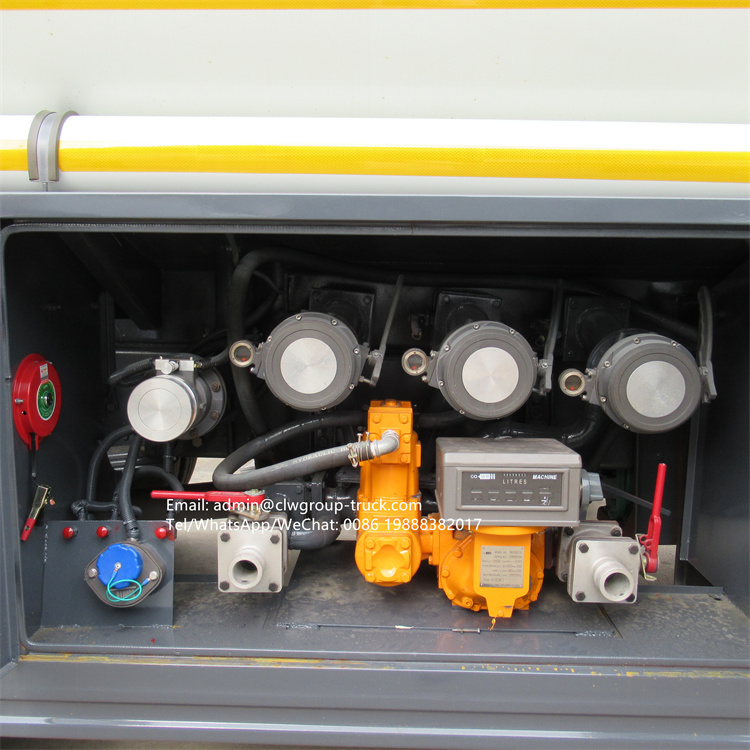
The main product accessories of the bottom loading oil tanker are: manhole cover, oil and gas recovery valve, oil and gas recovery joint, submarine valve (emergency shut-off valve), oil discharge valve, anti-overflow sensor, etc. The product has the advantages of reasonable design, advanced technology, safety and reliability, energy saving and environmental protection.

1. Subsea valve
The subsea valve, also known as the emergency shut-off valve, is installed at the bottom of the tank and is used when filling and refueling. It is easy to operate, time-saving, safe and environmentally friendly.
The pressure-balanced subsea valve is used for multi-silo tank trucks, and can be loaded and unloaded separately from different oil tanks. The three-way design simplifies the pipeline, reduces the load, and is easy to operate, safe and reliable. The pneumatic shut-off valve is installed at the bottom of the tank body of the oil tanker and can be refueled. The internal pressure of the valve is small and the flow rate is large. There is a cut-off groove on the flange of the valve body. If the force is too large, the body pipeline and the tank will be automatically disconnected, while the automatic centering plunger and durable spring will remain sealed, and the medium in the tank will not leak, thus ensuring the safety of the tank. When there is no air source or cannot be opened due to other reasons, the cylinder piston rod can be folded and opened manually.
2. Oil and gas recovery valve
The oil and gas recovery valve is a device that recovers the oil and gas generated when loading and unloading oil. It can be directly installed on the top tank of the tanker or on the manhole cover. It can be connected to the seabed at the bottom of the tank through a push rod. The valve is opened and closed by mechanical linkage, and its opening and closing can also be controlled by the air source.
The oil and gas recovery valve can recover all the oil and gas produced by the volatilization of oil during loading and unloading into the oil tank in the reservoir area, avoiding the leakage of oil and gas, and condensing and reusing the oil and gas through other oil and gas recovery devices, so as to achieve the purpose of energy saving and environmental protection.
3. Oil and gas recovery joint
The oil and gas recovery system of the oil station is composed of a flame arrester breathing valve, a pipeline flame arrester, a three-way floating ball valve, an oil and gas recovery joint, and a gas recovery quick joint. The oil and gas generated during the refueling process of the station are recycled and reused, avoiding the diffusion of oil and gas.
4. Bottom valve
The bottom loading valve, also known as the unloading valve, is installed under the side of the tanker for quick unloading. The front-end interface conforms to the American API Rp1004 standard, which is convenient to connect with the oil discharge hose. The internal structure of the fluid mechanics design can reduce the internal pressure to a min when the flow is large. The outlet adopts a flat bottom structure, and there is no oil leakage when the joint is disassembled, which is safe and reliable. The quick unloading hose joint adopts a 70-degree oblique design, which is convenient for hose connection and effectively improves the service life of the hose.
5. Anti-overflow probe
Uses: The anti-overflow electronic sensor is widely used in a safety device that alarms in advance in order to prevent the liquid from overflowing and leaking when all kinds of containers are filled with liquid. It is installed on the top manhole cover of the container. When the position reaches the warning limit, the sensor will automatically alarm and break the brake.
6. European standard manhole

Also known as manhole cover, it is installed on the top of the oil tank and has built-in breathing and emergency exhaust functions. Oil and gas recovery valves, oil measuring holes, anti-overflow probe rods, etc. can be installed on the manhole cover. The anti-overflow sensing system is in During the oil filling process, when the liquid level reaches the detection position, the sensing system will automatically alarm, thus stopping the oil filling. The built-in breathing valve keeps the internal pressure of the oil tank stable during oil transportation and balances with the external pressure. Its dumping and overflow prevention design keeps the oil tanker sealed in the event of an accident, and the emergency exhaust device keeps the pressure inside the tank. In the case of a sharp rise, it will automatically open to release the pressure in the tank, thereby preventing accidents and greatly improving the safety of oil transportation