Dump truck is a kind of truck with automatic dumping device in the cargo part. Also called dump truck. It is composed of automobile chassis, hydraulic lifting mechanism, cargo compartment and power take-off device.
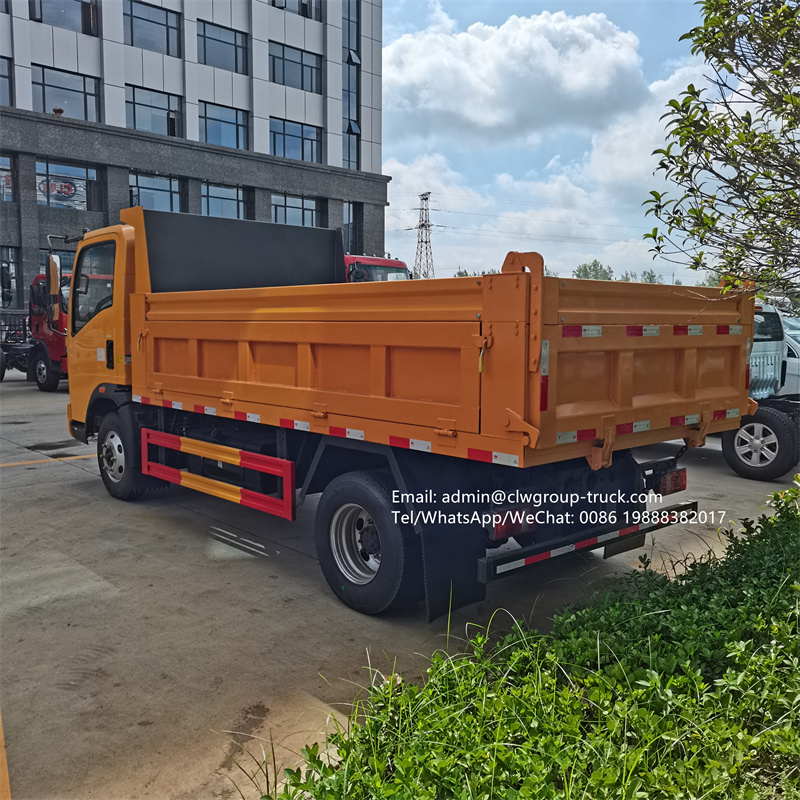
Sinotruk light truck dump truck is a popular small dump truck
Dimensions: 5995*2390*2800mm’
Compartment size: 3800/4200*2200*500/800
Carriage Material: Carbon Steel Side 3mm Bottom 4mm
Control system; hydraulic mid-top
Engine: Yunnei Engine 116 hp
Transmission: 6-speed gearbox
Front and rear axles: front axle 2.4 tons, rear axle 4.2 tons
Tire: 7.00R16
Wheelbase: 3360mm
Scope of application:
In civil engineering, dump trucks often work in conjunction with construction machinery such as excavators, loaders, and belt conveyors to form a loading, transportation, and unloading production line for the loading and unloading of earth, sand, and bulk materials.
working principle
The structure of the engine, chassis and cab of a dump truck is the same as that of a general truck.
The carriage of the dump truck is divided into two types: rearward tipping and sideward tipping. The movement of the piston rod is controlled by the control system. Backward tipping is more common. Pushing the piston rod causes the carriage to tip over, and a few tipping in both directions.
The high-pressure oil enters the lifting hydraulic cylinder through the distribution valve and the oil pipe, and there is a cab safety protection plate at the front end of the carriage.
The engine drives the hydraulic pump through the transmission and the power take-off device. The hydraulic tilting mechanism of the carriage is composed of a fuel tank, a hydraulic pump, a distribution valve, a lifting hydraulic cylinder, a control valve and an oil pipe. The hydraulic tilting mechanism of the carriage is composed of a fuel tank, a hydraulic pump, a distribution valve, a lifting hydraulic cylinder, a control valve and an oil pipe.
The engine drives the hydraulic pump through the transmission and the power take-off device, and the high-pressure oil enters the lifting hydraulic cylinder through the distribution valve and the oil pipe, and pushes the piston rod to overturn the carriage. Lateral tipping is more common, and the movement of the piston rod is controlled by the steering system to stop the carriage in any desired tilted position. The carriage is reset by its own gravity and hydraulic control


