
First of all, as everyone knows, the reason why the sewage suction truck and the fecal suction truck can absorb sewage and feces is because of the air pressure in the tank. When the air in the sewage suction tank is thinner than the outside world, a negative pressure will be generated, and the feces will be at atmospheric pressure. Under the action, it enters the tank through the suction and discharge pipe to realize the suction operation. When there is more air in the tank than the outside world, compressed air is formed, and positive pressure is generated. Under the action of atmospheric pressure, the feces are discharged from the tank through the suction and discharge pipe to realize the forced discharge operation.

1. Tanks of sewage suction trucks and fecal suction trucks
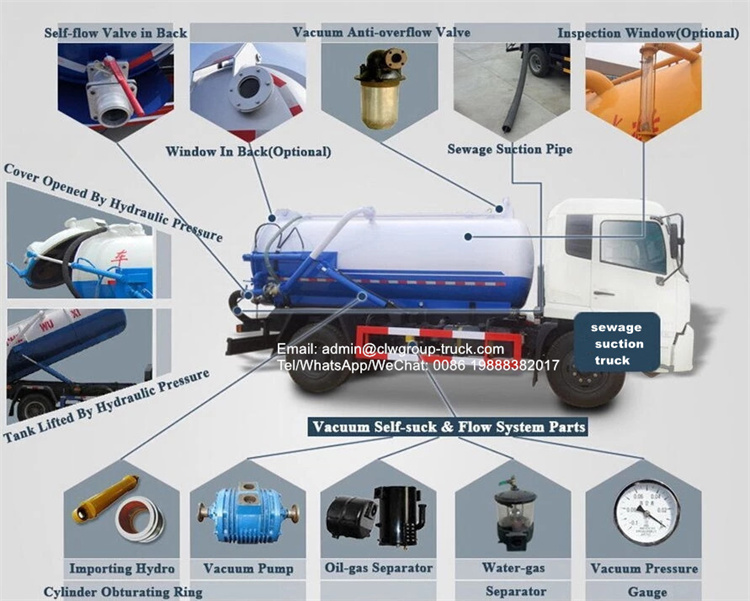
The tank is one of the main bodies of the sewage suction truck and the fecal suction truck, which occupies the largest space and is used to accommodate sewage and feces. The tank body of the sewage suction truck is cylindrical, with semicircular ends at both ends, and the section near the parking space can be opened. The tank body of the manure suction truck is an elliptical cylinder. Both ends of the tank body are welded to death. A manhole is opened at the top of the tank body. The manhole cover is usually sealed and only opened during maintenance. The tank body of the sewage suction truck and the fecal suction truck is welded with a wave-proof baffle, which can reduce the damage to the tank body and the frame connecting parts caused by the liquid shock and vibration when the vehicle is running. amount to prevent the liquid level from being too high. The lower part of the rear end of the tank is also equipped with a valve, the lower part of the tank is welded with a lower frame, a buffer pad is installed between the lower frame of the tank and the frame, and the lower frame of the tank and the frame are fastened with bolts.
2. PTO
The power of the engine drives the operation of the vacuum pump through the power take-off and the transmission shaft. The power take-off is mounted on the gearbox, and the switch button is located in the cab. The power take-off is composed of an input gear, an intermediate gear, an output gear, a gear shaft, a shift fork shaft, a shift fork and a handle. The input gear is in constant mesh with the transmission output gear. Before starting the vacuum pump, the transmission should be put into neutral, then start the engine, disengage the clutch, and turn on the power take-off switch. At this time, the shift fork shaft moves forward, and the power is transmitted from the transmission output gear to the power take-off input gear. The gear is transmitted to the output gear, and then the gear shaft is transmitted to the transmission shaft through the coupling, thereby driving the vacuum pump to operate.
3. Hose
The hose is generally made of carbon steel pipe or rubber pipe with steel wire. Because it needs to withstand pressure, it needs to have a certain strength. The hose starts from the sewage suction tank and runs through the water vapor separator, four-way valve, sewage suction pump, and oil and gas separator. No matter suction or forced discharge, the air must pass through the hose.
4. Vacuum pump
Vacuum sewage suction trucks and fecal suction trucks can realize sewage suction and sewage discharge. When the vacuum pump is running, the air is pumped out or pressed into the tank through the air pipeline system to achieve the purpose of suctioning liquids such as feces and sewage. When the sewage suction truck and the fecal suction truck are pumping or discharging sewage, the rotation direction of the vacuum pump is unchanged.
7. Oil and gas separator
The air discharged from the vacuum pump has a certain pressure and high speed, and when it breaks through the oil film layer, it carries a large number of oil droplets. In order to reduce fuel consumption and prevent pollution, an oil and gas separator is installed. The oil and gas separator is connected to the vacuum pump in the front through the trachea, and the oil storage tank in the rear. There is an oil blocking pipe in the oil and gas separator. When the compressed air enters, its volume suddenly expands, the flow rate decreases, the flow direction is changed, and it flows out through the porous oil retaining pipe. Due to the decrease in the flow rate of oil and gas molecules, the impact on the wall of the device and the hole wall is intensified, and a part of the heavy oil molecules is attached to the wall of the device, and forms oil droplets after condensation. flow to the top of the fuel tank.
8. Oil storage tank (or secondary oil and gas separator)
The oil storage tank (or the secondary oil and gas separator) is connected to the oil and gas separator at one end and a four-way valve at the other end. The oil storage tank has the functions of oil and gas separation and oil storage. The compressed air flowing into the compressor must pass through multiple obstacles before it can be discharged to the four-way valve. Due to the sudden increase in the volume of the oil storage tank, the air flow rate is significantly reduced, coupled with obstacles such as the oil blocking net, the oil molecules in the compressed air aggravate the collision. , attached to the inner wall and the mesh surface, and then flows into the bottom, and the compressed air that has been purified again flows to the four-way valve. There is a straight-through cock under the oil tank, which can control the amount of lubricating oil supplied to the vacuum pump, and a liquid level pipe, which can observe the oil storage amount and oil quality. The oil level of the oil storage tank should be in the middle or slightly lower than the middle of the liquid level pipe. Too much oil supply will affect the oil and gas separation effect, which will increase the oil consumption. If it is too low, it will affect the cooling and make the temperature of the vacuum pump rise too fast. The size of the oil supply is controlled by a straight-through cock. When the rotary handle is at right angles to the axis of the oil inlet pipe, it is fully open, and when it is parallel, it is fully closed. When the inspection finds that there is obvious oil mist at the exhaust port of the four-way valve, the oil supply should be reduced.
9. Liquid level alarm device
The liquid level alarm device is installed on the top of the tank and consists of a sensor probe, a sounder and its switch, and a dashboard. The sensing probe is located in the front of the tank, 100mm from the top, and is insulated from the tank. The sounder and its switch are fixed on the instrument panel, installed in the cab, and connected to the power supply when working. When the liquid in the tank continues to increase and the liquid level submerges the sensor probe, the liquid level alarm circuit is automatically turned on, and the beeper immediately emits light and sound to convey the information of "the suction volume is in place" to the driver.
10. Anti-overflow valve
During the sewage suction operation, if the tank is full but not closed in time and continues to absorb sewage, the sewage will be sucked into the water vapor separator along the trachea, and sprayed from the four-way valve to the outside ,polluted environment. In severe cases, it will also be sucked into the vacuum pump and oil and gas separator, we call this situation an overflow tank. In order to prevent the overflow of the tank, an anti-overflow valve is installed at the section where the air pipe is connected to the sewage suction tank. When the sewage in the tank is full, the sewage lifts the anti-overflow float in the anti-overflow valve, and the anti-overflow float rises to block the air pipe. Let the sewage spill out.